
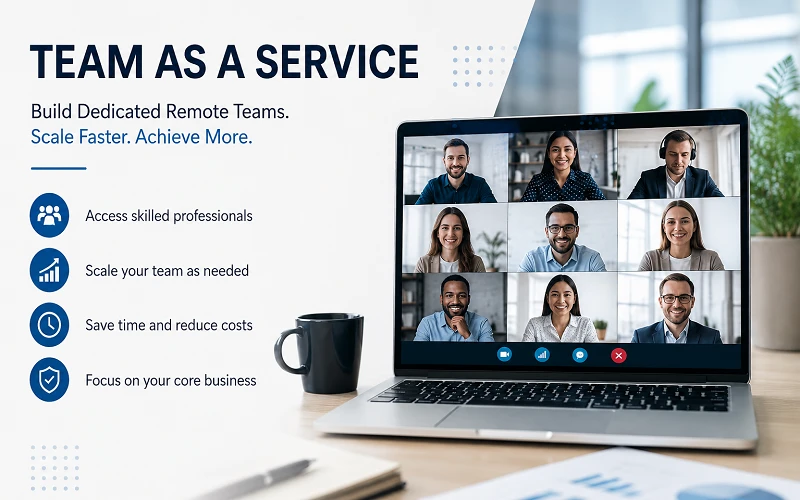
Businesses today face constant pressure to move faster. Whether a company is developing software, designing infrastructure, managing construction projects, or launching digital products, the need for skilled professionals often outpaces traditional hiring cycles. Recruiting full-time employees can take months, involve high costs, and require ongoing investment in training, management, and retention.
In response, many organizations are adopting a more flexible workforce model known as Team as a Service (TaaS). This approach gives companies access to dedicated remote professionals who integrate into existing workflows without the complexity of building and managing a complete in-house team from scratch.
What Is Team as a Service?
Team as a Service (TaaS) is a staffing model in which a company partners with a specialized provider to gain a fully dedicated team of professionals. These individuals work exclusively on the client’s projects while remaining employed by the service provider.
Instead of hiring people one role at a time, businesses receive a coordinated group that may include:
- Software developers and engineers
- Solution architects
- Project managers
- Quality assurance specialists
- UI/UX designers
- DevOps engineers
- Cybersecurity experts
- Technical support staff
- Domain specialists (engineering, architecture, construction support, etc.)
Unlike traditional outsourcing, where a vendor typically delivers a finished product with limited day-to-day involvement, a TaaS team functions as an extension of the client’s organization. Team members join meetings, use the same collaboration tools, follow internal processes, and communicate regularly with in-house staff.
The core goal is straightforward: give companies experienced professionals who can begin contributing quickly while reducing hiring delays, administrative burden, and long-term employment overhead.
How Team as a Service Differs from Other Hiring Models
Although TaaS shares some similarities with freelancing, outsourcing, and staff augmentation, the differences in structure, collaboration, and long-term suitability are significant.
Team as a Service vs. Freelancing Freelancers are typically engaged for short-term tasks or narrowly defined deliverables. Managing multiple independent freelancers often creates communication gaps, inconsistent quality, and coordination overhead. A TaaS arrangement provides a cohesive team that already works together under unified processes, shared tools, and consistent standards, resulting in greater stability and continuity.
Team as a Service vs. Traditional Outsourcing Classic outsourcing frequently hands over an entire project to an external vendor with limited client visibility. The provider controls execution and delivers the final result. In contrast, TaaS keeps the client actively involved in prioritization, planning, and day-to-day collaboration. The remote team operates inside the client’s workflow rather than outside it.
Team as a Service vs. Staff Augmentation Staff augmentation adds individual specialists to an existing team. TaaS goes further by supplying a complete, pre-coordinated group that already understands how to collaborate. Instead of filling one vacancy, the company gains a functional unit capable of supporting larger or longer-term initiatives.
Why Companies Are Turning to Team as a Service in 2026
Several market realities are accelerating adoption of this model:
- Projects move faster and deadlines are tighter
- Technology stacks evolve continuously
- Competition for specialized talent remains intense
- Businesses need the ability to scale capacity up or down without long-term employment risk
These pressures make flexible, ready-to-deploy teams increasingly attractive.
Faster Access to Talent
Traditional recruitment involves writing job descriptions, posting openings, screening resumes, conducting multiple interview rounds, negotiating offers, and completing onboarding. The process can easily stretch across weeks or months. With a TaaS provider, vetted professionals are already available, allowing companies to assemble a working team in a fraction of the time and begin productive work much sooner.
Lower Overall Cost of Talent
Hiring full-time employees carries costs beyond salary. Companies must also account for recruitment fees, benefits, equipment, software licenses, training, HR administration, and potential severance. Under a TaaS arrangement, many of these responsibilities remain with the service provider. Organizations gain access to experienced professionals without carrying the full long-term financial and administrative burden of permanent headcount.
Flexible Scaling
Project needs rarely stay constant. A development phase may require additional engineers for several months, while post-launch support might need only a smaller team. TaaS allows companies to:
- Scale up by adding developers, specialists, or managers when demand increases
- Scale down after peak periods without managing layoffs or complex employment transitions
This elasticity helps organizations align talent costs more closely with actual workload.
Access to a Broader Talent Pool
Local hiring markets can be limited, especially for specialized skills in areas such as cloud architecture, artificial intelligence, cybersecurity, or advanced engineering. TaaS removes geographic constraints and opens access to professionals across regions and time zones, expanding the range of available expertise.
Industries That Benefit Most from Team as a Service
While the model can support many sectors, it is particularly valuable in fields that rely on specialized technical knowledge and project-based work.
Software Development and IT Technology companies frequently use dedicated remote teams for:
- Building web, mobile, and enterprise applications
- Cloud platform development and migration
- DevOps, CI/CD pipelines, and infrastructure automation
- Cybersecurity monitoring and hardening
- Quality assurance and testing
- Ongoing technical support and maintenance
Engineering Engineering organizations use remote specialists for mechanical, civil, electrical, and industrial engineering support. These professionals help maintain project momentum and quality standards without the delays of permanent local hiring.
Architecture Architecture practices engage remote talent for building design, 3D modeling, CAD drafting, and Building Information Modeling (BIM) coordination. Distributed collaboration tools make cross-location work increasingly practical.
Construction Construction firms rely on remote technical support for project planning, cost estimation, scheduling, documentation, structural analysis, and engineering coordination. This improves capacity during peak periods while reducing permanent staffing pressure.
Best Practices for a Successful Team as a Service Partnership
Results depend heavily on how the engagement is structured and managed. Organizations that achieve the strongest outcomes typically follow these practices:
- Define clear goals, success metrics, and timelines from the start
- Establish explicit roles and responsibilities for both the remote team and internal stakeholders
- Maintain regular, structured communication through shared tools and scheduled check-ins
- Integrate remote professionals into existing workflows and knowledge-sharing processes
- Provide timely feedback and conduct periodic performance reviews
- Treat the team as a long-term collaborative partner rather than a temporary vendor
Strong alignment and consistent communication are usually more important than any single technical skill.
Common Challenges and Practical Solutions
Like any distributed model, TaaS comes with potential friction points. Most can be managed effectively with preparation:
Time zone differences Flexible scheduling and intentional overlap hours usually resolve coordination issues.
Communication and cultural differences Clear expectations, documented processes, and regular interaction help build mutual understanding and smoother collaboration.
Security and data protection Secure access controls, confidentiality agreements, role-based permissions, and well-defined data-handling policies reduce risk.
Knowledge continuity Documenting processes and encouraging knowledge transfer between remote and internal team members protects institutional knowledge over time.
Final Thoughts
Team as a Service has emerged as a practical alternative to traditional hiring for organizations that need specialized talent without the delays and long-term commitments of permanent recruitment. By combining faster access to professionals, flexible scaling, reduced operational overhead, and broader geographic reach, the model supports both short-term project delivery and longer-term growth.
For founders, project leaders, and HR decision-makers evaluating workforce strategy in 2026, TaaS offers a structured way to build capable teams that can adapt as business needs evolve. Success depends less on the model itself and more on clear goals, disciplined collaboration, and treating remote professionals as genuine extensions of the organization.
When implemented thoughtfully, Team as a Service can become a durable competitive advantage rather than a temporary staffing workaround.
