
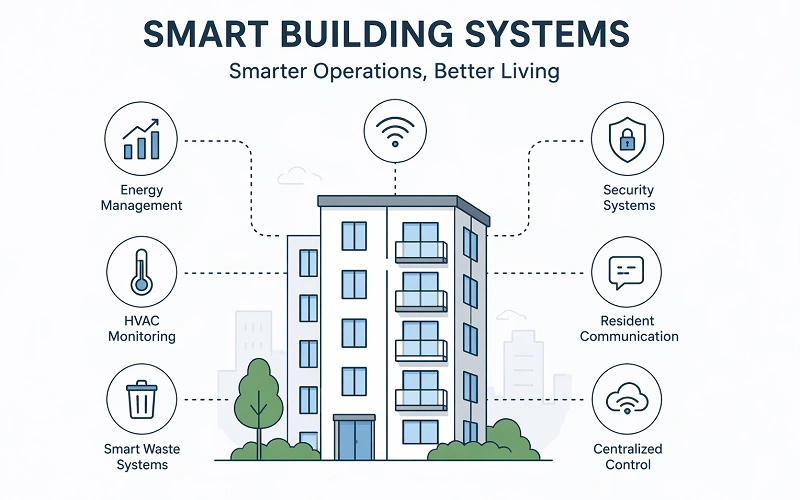
Modern apartment operations run on precision. Every system inside a building contributes to how smoothly daily life unfolds for residents and how efficiently teams manage the property. Performance is no longer judged by how quickly problems get fixed, but by how consistently everything runs without interruption. Expectations have moved toward stability, predictability, and seamless coordination across all building functions.
Smart building systems bring manageability into that environment. Continuous data streams reveal how equipment behaves, how energy flows through the property, and how indoor conditions shift throughout the day. Managers gain access to patterns that were previously hidden within routine operations.
With this visibility, decisions become more informed and aligned with actual building performance rather than assumptions.
Early Issue Detection
Mechanical systems communicate through performance patterns long before visible disruption occurs. Subtle changes in airflow, longer operational cycles, and uneven temperature distribution across units all signal shifts in system behavior.
Smart monitoring platforms capture these variations with accuracy. Performance data highlights where attention is needed and when intervention should take place. At this stage, HVAC repair becomes a strategic requirement supported by skilled professionals who understand system behavior at a deeper level. Experienced technicians interpret performance data, apply targeted solutions, and maintain consistent comfort across units. Their expertise transforms early signals into controlled, efficient system performance.
Centralized Control
Building operations involve multiple systems working simultaneously across units and shared spaces. Clear oversight requires a unified view that brings all these elements together.
Centralized dashboards provide that control. A single interface allows managers to monitor performance across the entire property, identify irregularities, and respond with clarity. Complete visibility supports faster decisions and maintains alignment across all operational areas.
Faster Response Times
Timely action shapes how effectively building systems operate. Quick response keeps small issues contained and supports continuous performance.
Automated alerts deliver immediate updates the moment a system registers a variation. Maintenance teams receive direct notifications, allowing them to act with precision and speed. Timely action preserves system stability and supports a consistent experience for residents.
Energy Management
Energy usage reflects how efficiently a building operates throughout the day. Fluctuations in demand require accurate insight to maintain balance across systems.
Real-time data provides that insight. Managers can track usage patterns, adjust system output, and align performance with actual demand. Controlled energy management supports efficiency while maintaining comfort across all units.
Long-Term Planning
Sustained performance depends on structured maintenance planning supported by accurate data. Clear insights into system behavior guide decisions that maintain reliability over time.
Performance trends highlight when systems require attention, allowing maintenance to be scheduled with precision. Structured planning supports consistent operation, reduces disruption, and strengthens overall building performance.
Digital Twin Technology
Digital twin technology gives building management something far more powerful than reports or past data. It creates a living model of the property that behaves the way the real building does, capturing how systems interact, how spaces are used, and how conditions shift throughout the day. Instead of making adjustments and waiting to see the outcome, managers can test ideas in a controlled environment where every change reveals its full impact.
A shift in airflow, an adjustment in energy distribution, or a change in system timing can all be explored in advance, showing how one decision influences multiple parts of the building at once.
Planning becomes sharper and far more intentional through this approach. Maintenance strategies, upgrades, and system changes can be refined before anything is implemented on-site, reducing disruption and improving accuracy. Patterns that would normally take months to notice start becoming visible within the model, allowing teams to understand how the building behaves over time.
Equipment performance, energy trends, and usage cycles all come into clearer focus, creating a stronger foundation for both daily management and long-term decisions.
Smart Waste Systems
Waste management has traditionally followed routine rather than need, with fixed collection schedules that rarely match actual usage. Some areas fill quickly and require immediate attention, while others remain underused yet still follow the same pickup cycle. This creates inconsistency across the property, where certain spaces feel neglected during peak times while others receive unnecessary service.
Smart waste systems introduce a more responsive way of managing this process. Sensors track fill levels in real time, allowing collection to be scheduled based on actual demand rather than assumptions. High-use zones receive timely attention, while low-traffic areas remain efficient without excess servicing. Collection routes become more precise, reducing unnecessary movement and improving coordination with service teams.
System Integration
Multiple building systems operate at the same time, each handling a different part of daily functionality. Coordination across these systems plays a major role in maintaining smooth operations.
Integrated platforms bring these systems into alignment. HVAC, lighting, water, and security systems communicate through shared data, allowing actions in one area to support another. A temperature adjustment in one zone can align with occupancy data, while energy use can adapt based on real-time conditions. This level of coordination creates a more structured and efficient operating environment.
Resident Communication
Clear communication strengthens the relationship between management and residents. Information about maintenance, system updates, or environmental conditions shapes how residents experience the property.
Digital tracking tools support this communication with accuracy and speed. Updates can be shared in real time, allowing residents to stay informed without delay. Visibility into ongoing work or system performance builds confidence and supports a more transparent living environment.
Air Quality Monitoring
Indoor conditions influence comfort at a level that often goes unnoticed until performance shifts. Air quality, humidity, and temperature all contribute to how residents experience their space throughout the day.
Smart sensors continuously track these conditions. Data provides insight into how indoor environments change, allowing adjustments that maintain consistency. Stable air quality and balanced conditions support a more comfortable and controlled atmosphere across all units.
Scalable Operations
Growth within an apartment complex introduces additional operational demands. Expanding systems while maintaining performance requires a structure that can adapt without disruption.
Scalable smart systems support this expansion. New units, additional equipment, and increased demand can be integrated into existing frameworks without loss of efficiency. Consistent performance remains intact as the property evolves, allowing management to maintain control across a growing environment.
Wrap Up
Smart building systems bring a level of precision into apartment operations that supports consistency, efficiency, and control. Continuous data, integrated systems, and real-time communication shape a structure where decisions align closely with actual performance. Operations move with clarity, supported by insight rather than assumption, creating an environment that maintains stability across both daily routines and long-term management.
