Did you know that credentialing a single healthcare provider in the United States can take 60 to 120 days, and sometimes even longer, depending on the payer? Now imagine running a busy medical practice where it could take months to be approved by insurance networks.
Sounds frustrating, right?
This is the reality happening to many healthcare providers. They attend to patients, give them good care, make claims, and only to notice that the payments are being delayed and credentialing has not been made.
So, the real question becomes: Who should handle credentialing?
Should your practice manage it internally with staff members, or should you rely on outside experts who specialize in credentialing?
For many busy healthcare practices across the United States, choosing the right approach can make a big difference in revenue flow, efficiency, and overall stress levels.
Let’s explore both options and see which route actually makes sense.
Why Credentialing Is a Critical Step for Healthcare Practices
It is beneficial to comprehend why credentialing is so important before making a comparison between the two approaches.
Provider credentialing is a procedure of determining the education, licenses, certification, training, and professional history of a healthcare professional prior to their involvement in insurance networks.
This process is used by insurance companies to ascertain that the required standards of care are achieved by providers.
But here’s an interesting fact: most insurance companies will not reimburse claims until credentialing is fully approved.
That means if a provider starts seeing patients before enrollment is finalized, those services might not get paid.
For a growing practice, this can create a serious financial gap.
The In-House Credentialing Approach
Most of the practices attempt to handle credentialing internally. It might appear the most feasible choice, as at least your team takes care of the scheduling, billing, and administrative duties.
The introduction of credentialing into the list may seem to be quite an easy task.
But what does in-house credentialing actually involve?
Staff members must:
- Complete detailed payer applications
- Verify provider licenses and certifications
- Maintain CAQH profiles
- Track enrollment deadlines
- Respond to payer requests for additional documentation
- Monitor application status with multiple insurance companies
And that is just the beginning.
Credentialing is also not a single process. The insurance networks require providers to renew licenses, update credentials, and revalidate with networks periodically.
Without a clear system in place, small mistakes can quickly turn into costly delays.
The Benefits of Handling Credentialing Internally
Despite the challenges, some practices prefer keeping credentialing in-house.
There are a few advantages to this approach.
Direct Control Over the Process
With internal credentialing, practice managers can see all the steps that come into play. Payer communication, documents, and applications are in the organization.
This can be attractive to practices that place importance on full administrative control.
Immediate Access to Information
In case a payer needs documentation or clarification, in-house employees can easily find and provide the necessary information.
No coordination with an external vendor is required.
Familiarity with Practice Operations
Internal personnel are familiar with the functioning of workflow, provider schedules, and documentation systems that are already in use in the practice.
This familiarity can sometimes simplify communication.
However, despite these benefits, the fact is that credentialing is time-consuming and takes up a lot of expertise.
The Challenges of In-House Credentialing
Credentialing is proven to be much harder than thought by many practices.
One of the biggest issues is time.
Administrative teams usually have various duties including scheduling patients, following up with insurance company bills, checking insurances, and compliance issues.
Credentialing may be a bottleneck when it is added to an already full workload.
These are some of the issues that practices face with in-house credentialing:
- Missed deadlines for payer enrollment
- Incomplete documentation
- Delays in CAQH updates
- Lack of follow-up with insurance companies
- Limited understanding of payer-specific rules
Any minor mistake in an application can revert it to the start of the reviewing process and that can easily put weeks or months on approval schedules.
Outsourcing Credentialing: A Growing Trend
Due to these complications, most healthcare organizations are more likely to outsource credentialing to professionals.
Credentialing firms are solely concerned with provider enrolment and verification.
Their teams understand payer requirements, documentation standards, and application processes in detail.
But why are so many practices moving toward this approach?
One reason is efficiency.
Structured workflows and tracking systems are usually employed by credentialing specialists, and they will be useful in avoiding delays.
They also have frequent contacts with insurance companies, which may accelerate approvals.
Advantages of Outsourcing Credentialing
Outsourcing credentialing can provide several important benefits for busy practices.
Faster Enrollment Approvals
Credentialing professionals are familiar with the paperwork needed to have various insurance networks. Due to this experience, they usually make more correct applications at the first time.
This reduces the chances of rejection or additional review requests.
Reduced Administrative Burden
Rather than requesting the internal personnel to handle credentialing efforts, practices may enable them to concentrate on the patient services, scheduling and the revenue cycle activities.
This improves efficiency across the organization.
Better Tracking and Organization
Credentialing specialists maintain organized records, track renewal deadlines, and monitor payer responses regularly.
This proactive approach will avoid such gaps in credentialing that may disrupt reimbursements.
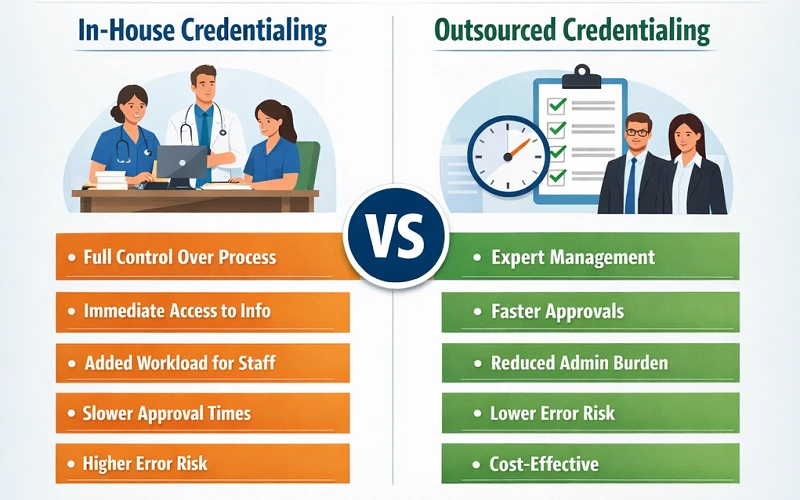
In-House vs Outsourced Credentialing: Quick Comparison
The differences between these two approaches become clearer when we compare them side by side.
| Factor | In-House Credentialing | Outsourced Credentialing |
| Control | Full internal control over documents and communication | Managed by credentialing experts |
| Staff Workload | Adds extra responsibilities to existing staff | Reduces administrative burden |
| Approval Speed | May be slower due to limited experience | Often faster due to specialized expertise |
| Cost Structure | Salary and training costs for staff | Service-based cost structure |
| Error Risk | Higher risk if staff lacks credentialing expertise | Lower risk with experienced specialists |
| Tracking and Follow-Up | May be inconsistent due to workload | Regular monitoring and follow-ups |
This comparison helps practices evaluate which option aligns better with their operational needs.
Finding the Right Balance for Your Practice
Every healthcare practice operates differently. What matters most is ensuring that credentialing does not slow down patient care or disrupt revenue.
When providers spend less time worrying about enrollment paperwork and more time focusing on treatment, the entire healthcare system benefits.
For many growing medical organizations across the country, doctormgt.com is exactly why outsourcing has become a practical solution.
And for practices looking to reduce delays, improve accuracy, and keep insurance approvals moving smoothly, partnering with experienced provider credentialing services can often be the most reliable way to stay organized while supporting long-term practice growth.